
Martial Arts Point of Sale That Drives Growth
A martial arts point of sale should do more than process payments. Learn what features improve billing, retention, reporting, and control.
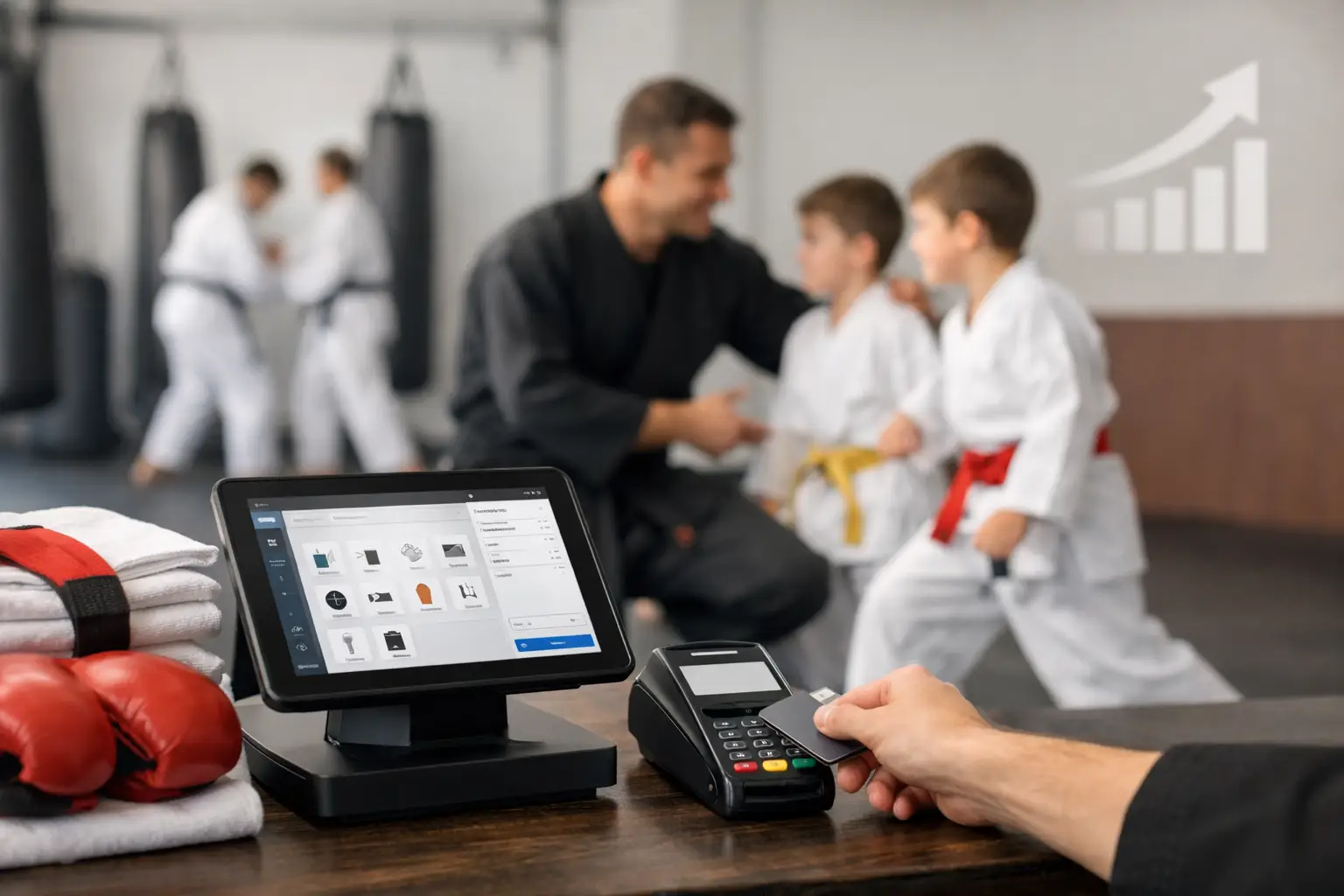
If your front desk still jumps between a card terminal, a spreadsheet, a waiver folder, and a separate billing tool, you do not have a system. You have a patchwork. A martial arts point of sale should bring sales, memberships, attendance, and collections into one operational workflow so your academy runs tighter and earns more from the members you already have.
That matters because martial arts schools are not standard retail businesses. You are not just ringing up gloves and uniforms. You are managing recurring tuition, family accounts, intro offers, rank progression, attendance habits, failed payments, instructor visibility, and often multiple programs under one roof. A generic POS can process a transaction. It cannot run a school.
What a martial arts point of sale actually needs to handle
The real job of a martial arts point of sale starts after the payment goes through. Yes, you need to sell merchandise, collect enrollment fees, and take payments at the front desk. But the bigger operational win comes from connecting those transactions to the member record, the billing schedule, and the daily flow of the academy.
When a parent signs up two children for classes, the system should support a family profile, recurring billing terms, signed documents, attendance tracking, and account notes in one place. When a student upgrades into a leadership program, staff should be able to adjust the membership without creating billing confusion. When a payment fails, your team should not discover it three weeks later after revenue has already slipped.
This is where many schools lose margin. They rely on disconnected tools that force staff to re-enter information, manually chase balances, and piece together reports at month end. That creates avoidable admin work, slower collections, and limited visibility into what is happening across the business.
Why standard POS software falls short for martial arts schools
A martial arts academy operates on a membership model with retail layers, not the other way around. That distinction matters. Most point-of-sale systems are designed around one-time transactions first. Martial arts schools need recurring revenue management first, with POS functions built around it.
That means your software has to understand contracts, renewals, autopay schedules, down payments, installments, family discounts, and program changes. It also has to support operational details that are specific to training businesses, such as student level or belt rank, attendance patterns, instructor access, and class check-in.
If your POS stops at checkout, your staff picks up the difference manually. That is expensive. It increases errors, slows down the front desk, and makes it harder to hold teams accountable because information is scattered across different systems.
The features that directly impact revenue
The best martial arts point of sale platforms are not just administrative tools. They are revenue systems. They help you collect more consistently, spot problems earlier, and reduce the amount of labor tied to routine billing tasks.
Recurring billing automation
For most martial arts schools, recurring tuition is the financial core of the business. Your POS should automate scheduled billing, retries for failed payments, account notifications, invoices, and payment method updates. This shortens the gap between when revenue is due and when it is actually collected.
Automation also protects the member experience. Families should not have to hear from your staff only when something goes wrong. A well-configured system handles reminders, payment recovery workflows, and account visibility before an issue becomes a cancellation risk.
Integrated membership management
Selling a membership is only the beginning. Every change after signup matters. Freezes, upgrades, downgrades, add-on programs, sibling discounts, and renewals need to be controlled from the same system that processes payments.
When membership management lives inside the POS, your team works faster and leadership gets cleaner reporting. You can see which programs are growing, which accounts are falling behind, and where retention starts to soften.
Attendance and check-in
Attendance is not just a class management feature. It is a retention signal. Students who stop showing up often stop paying soon after, even if they have not officially canceled yet. A martial arts point of sale with integrated check-in helps you connect revenue data to participation behavior.
That gives operators a practical advantage. You can identify at-risk members earlier, coach staff to intervene, and make decisions based on actual engagement instead of assumptions.
Reporting that supports decisions
Most owners do not need more reports. They need useful reports. A good system should show recurring revenue performance, collections, delinquency, attendance trends, product sales, instructor activity, and location-level visibility without requiring manual spreadsheet cleanup.
For multi-location organizations, this becomes even more important. If every school runs its own process, leadership ends up comparing incomplete numbers. Centralized reporting makes it easier to spot which locations are disciplined, which ones need coaching, and where revenue leakage is happening.
Operational control matters as much as payment processing
Revenue grows when operations are disciplined. That is why the strongest systems go beyond transactions and include permissions, audit visibility, account history, and workflow consistency.
Front-desk teams should be able to complete daily tasks quickly without having unrestricted access to sensitive functions. Managers should be able to review changes to accounts, monitor exceptions, and catch errors before they become financial problems. Owners should not need to guess whether a missed payment was a member issue, a staff issue, or a system gap.
This level of control is especially valuable in martial arts schools with a lean staff model. Many academies operate with a mix of owners, program directors, instructors, and part-time front-desk help. A system that standardizes work reduces training time and keeps execution more consistent across shifts.
Choosing the right martial arts point of sale for your school
The right platform depends on how your academy operates now and where you want it to be in the next two to three years. A single-location school with one core program may prioritize ease of use and faster collections. A growing organization may need stronger reporting, role-based access, and more structure around multi-program memberships and cross-location oversight.
Either way, there are a few questions worth asking before you commit.
Can the system handle both front-desk sales and recurring tuition from the same member profile? Can it support family accounts without creating billing workarounds? Does it automate failed payment recovery, or will your staff still spend hours making calls and sending reminders? Can it track attendance and student progress in a way that is useful to both operations and instruction? And can leadership trust the reports without exporting everything into a manual spreadsheet process?
It also helps to look at payment economics, not just software features. Processing costs can quietly eat into margins, especially for schools with high recurring transaction volume. A system designed to optimize payment handling and reduce unnecessary merchant expense can have a measurable impact on profit over time.
What implementation looks like in the real world
Software only improves operations if your team actually uses it. That is why adoption matters as much as feature depth. The best systems are structured enough to tighten process but practical enough for front-desk teams to learn quickly.
For martial arts schools, implementation usually works best when it starts with the core revenue workflows first: active memberships, billing rules, payment methods, signed documents, and check-in procedures. Once those are in place, schools can layer in retail sales, automation rules, reporting views, and more advanced permissions.
There is always a trade-off between flexibility and control. Too much flexibility and staff create inconsistent workarounds. Too much rigidity and adoption slows down. The goal is to choose a platform that gives operators strong oversight while still letting the front desk move fast.
That is where a purpose-built system creates an advantage. BillingLogix brings POS, membership management, billing automation, reporting, check-in, and operational controls into one platform, helping martial arts businesses reduce admin drag and improve revenue visibility without stitching together multiple tools.
The bigger payoff is not faster checkout
A better martial arts point of sale does not just help you sell more at the counter. It helps you run a more disciplined business. It reduces missed payments, shortens collection cycles, gives your team clearer workflows, and turns member data into something operationally useful.
For martial arts school owners, that means more than convenience. It means stronger cash flow, fewer preventable losses, better team accountability, and more time spent improving the student experience instead of fixing admin problems. If your current setup cannot support that, the issue is not your staff. It is the system behind them.
The schools that grow cleanly are usually not doing dramatically more work. They are doing the right work inside a system built to support how a membership business actually runs.